

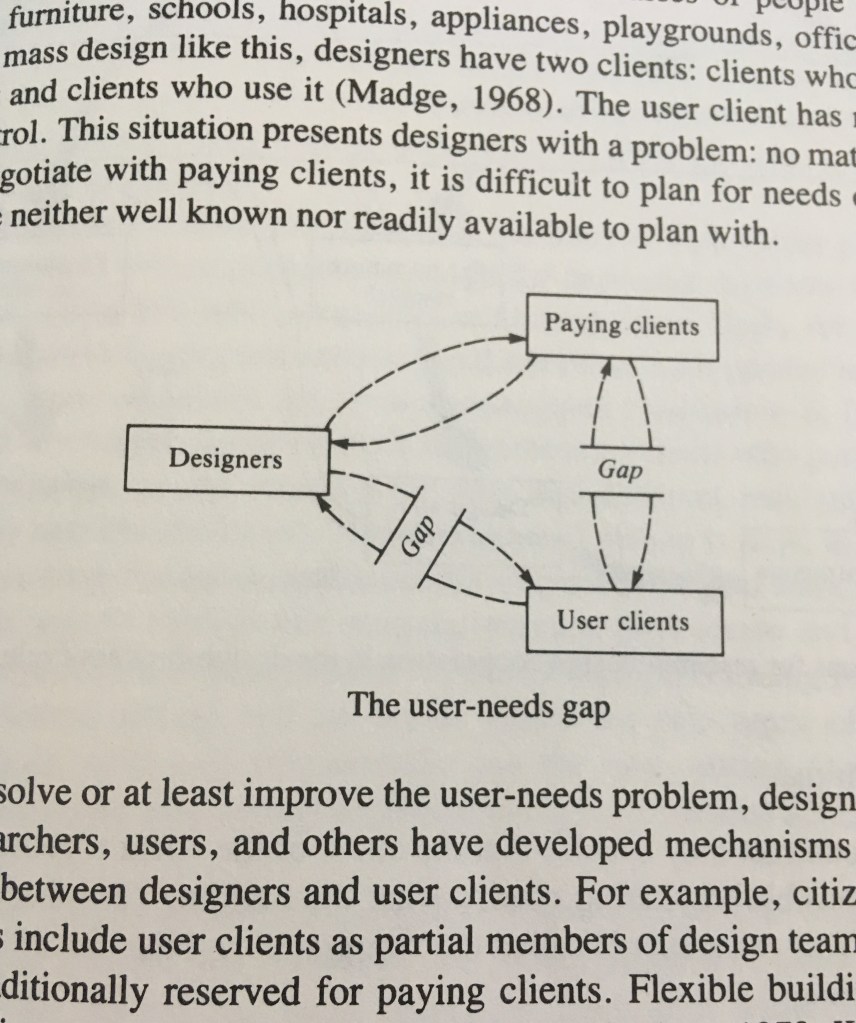
Zeisel’s examination of the fields of research and design builds into an account of how and why researchers and designers should collaborate. A key benefit to architects is that such collaboration helps to address the increasingly common separation of designers from the end-users:
Designers have two clients: clients who pay for what is built and clients who use it. The user client has no choice and no control.
Zeisel, 1981
By providing much needed information about the end-users of their design, environment-behaviour research helps architects to better design for the needs of those who will go on to inhabit these spaces.
The second part of Inquiry by Design breaks down each method used in environment-behaviour research which is proving highly informative in planning ethnographic research and case study analysis.
- Observing physical traces: how people have affected their physical surroundings
- Observing behaviour: how people use physical settings
- Interviewing: how individuals define specific situations they have experienced
- Questionnaires: perceptions, attitudes and aspirations that can be summarised across individuals to groups
 charlottestuart.design.blog